Showing posts with label fixed gear. Show all posts

Monday, July 29, 2024

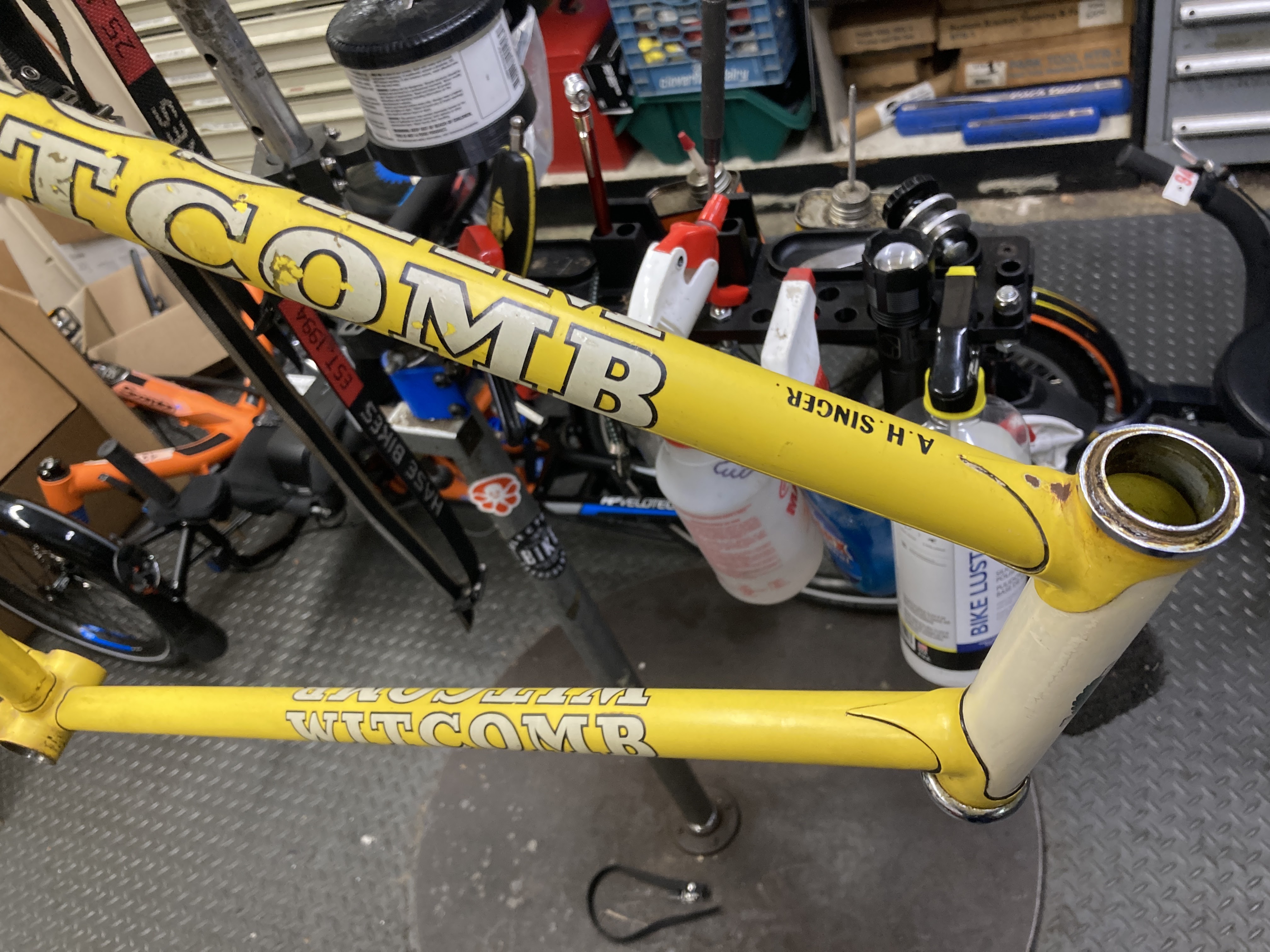
More progress on the 1963 Witcomb

 It's taken a while, but I've finally made some more progress on my 1963 Witcomb fixed gear bike.  After giving the frame and all the parts a really good cleaning, I started putting it back together.  I've kept most of the original parts, with a few significant changes for practical reasons.

Original tire and bent rim
First and probably biggest change, I rebuilt the wheels, using new stainless steel DT spokes, DT brass nipples, and some nice old MAVIC MA2 clincher style rims, laced to the original Campagnolo hubs.  The original rims were MAVIC Championnat du Monde, with some very old tubular (aka sewup) tires.  One of the two rims, I think the front, had a very serious dent in it, which rendered it useless.  I thought seriously about re-building with sewups, but the more I thought about it, the less appealing that was.  Sure, that would be the "correct" choice, but I really want this bike to be something I can ride regularly without a lot of worry.  As nice as sewups ride, the care and feeding is frankly more trouble than I want for this bike.

Rebuilt wheels and new tires
When building the wheels, I decided I would mimic the original spoke lacing patterns for the front and rear wheels.  The front wheel has 32 spokes, and were laced in a "cross three" pattern, while the rear has 36 spokes, laced "cross four."  While most production bikes would have had 36 spokes in both wheels, laced identically, a small, custom builder like Witcomb might do something different.  The rear wheel seems more weight and stress, so a "beefier" build makes a lot of sense.  Thus more spokes, with more crossings of each spoke. 

I do love the classic look of tan sidewalls, and a nice round cross-section and smooth tread, so I opted for a set of Rene Herse 700x32c Stampede Pass tires.  A bit fatter than what would have been on the bike originally, but I like some cush to my ride these days.  The Rene Herse tires are light and fast and supple, so these should make for a lovely ride.

Original headset
Another change I made was to swap out the headset.  The original was a Campagnolo Record, but someone somewhere along the line had painted the upper cup yellow, to match the frame.  I tried my best to clean the paint off, but the end result didn't look good at all, so instead I installed new loose bearing headset, the Tange Levin, a classic that looks a lot like the original Campy, works just as well, and doesn't cost a king's ransom, like a period correct Campy one would.  I figured from 5 feet away, nobody will know.

Finally, a new rear sprocket was installed, as well as a new chain.  The reason for this is because the original gearing was a bit high for the kind of riding I'm likely to do on this bike.  First, I'll be dealing with hills, and I'm also not as young as I once was.  So, instead of the 16 tooth sprocket originally installed, which gave a gear of 79 gear inches, I installed an 18 tooth, for 70 gear inches

Original brake levers
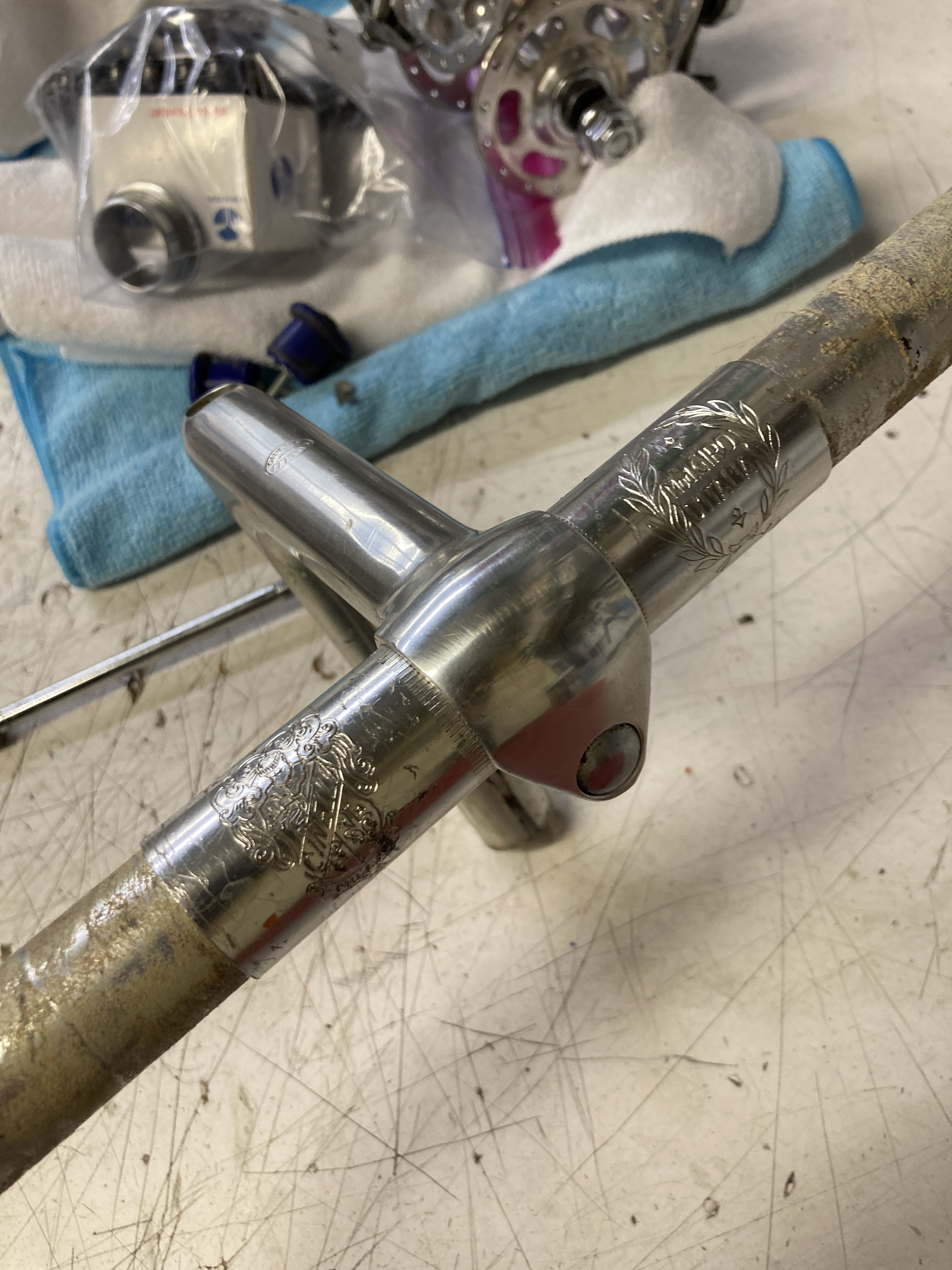
So, what's left?  Well, obviously, I need to wrap the handlebars, and since this is a classic from the 60s, I'll be using cotton tape for that.  Black would probably be the most straightforward choice, but I'm toying with other options.  You can't really tell from the photo, but the bike had blue cotton tape when I got it.  More important than tape, I need to install a front brake.  Some people ride "brakeless fixies" but not me, thanks.  I want a front brake on there just in case the chain breaks or comes off, and I also find it handy sometimes while riding.  The bike appears to have been built to have a front brake, and it had an old Weinmann when I got it, but it was not in good shape, so I will be installing something else.  I have a Universal Mod. 68 (introduced five years after the bike was built, but close enough for me) that I'm planning to install, with a matching lever.  The previous owner had a "dummy" lever on the right hand side, basically just the body without the lever, and I might do the same, as it makes a convenient hand grip when riding.


Oh, one final thing, pedals!  I'm going to put some modern, "clipless" SPD-compatible pedals on the bike to start with.  Yeah, they'll look a little weird, but I'm out of practice at flipping over and inserting my foot in toe clips on a fixed gear bike, so the SPDs will be easier to start with.  Eventually, I plan to put a more traditional "track" pedal with toe clips on there.  I actually like riding in toe clips sometimes, and they just seem right for this old bike.

For more on this bike:

Sometimes Bikes Find Me! 

1963 Witcomb Update

For an album of photos:

1963 Witcomb Fixed Gear Bike


What it looked like when I first got it.
What it looks like today!


Sunday, November 20, 2022

1963 Witcomb update

 Well, it's slow going, as I don't have a huge amount of spare time, but I'm chipping away at cleaning up and overhauling that Witcomb track bike I shared a few weeks ago.  It's pretty remarkable how well it's cleaning up.  It seems there was just a fine layer of filth over a bike in otherwise great shape.

I stripped all the parts off the frame, and gave it a good washing, first with diluted Dawn dish soap.  For the more stubborn bits of grunge, I used Simple Green, and in a few spots, a bit of denatured alcohol.  I had to be very sparing with the latter, or it would take up paint.  For the chromed parts of the rear triangle and front fork, I used Quick Glo, which works really well for cleaning up chrome and making it shine.  You can see the results below.

Before:


After:


I've also cleaned up most of the components, and have unlaced the wheels, since I won't be using the original sewup rims.  The front rim had a nasty dent in it, so it had to be replaced for sure, and since I was going to have to re-lace at least once wheel, I figured I'd swap out to clincher rims.  Clincher tires are just easier to deal with, and less expensive too.

Before:


After:


One odd thing I discovered is the bar tape was originally blue, and appears to have been two different shades of blue.  I never would have guessed this from what it looked like on the bike, but as I stripped it off the original colors were revealed.

There were a few paint chips, and rather than try to find a good match, I decided to just cover the bare steel with clear nail polish.  I'll be waxing the frame with Meguiar's carnauba wax, and then the next step is to start putting it all back together again.  I need to lace up the wheels of course, using the original hubs, new spokes, and a set of Mavic MA-2 rims a friend is sending me.  One oddity is that the bike has 32 spokes in the front, 36 in the rear.  Most bikes of this era had the same number of spokes in both wheels, but the British did things a bit differently sometimes.  It does make sense, as the rear wheel sees more stress than the front.

Stay tuned for more updates as things progress.

Photo album, with new additions:

1963 Witcomb Track Bike


Sunday, January 18, 2009

Yet Another Bicycle!

ANOTHER ONE?!?!?!?!? Well, um.... yes... bringing me to, well... er.... 18 and 1/2 bikes total right now. Yes, that's a lot of bikes!

What can I say? It's an obsession... I love bicycles! And I find it really, really hard to pass up a cool, classic, old steel bike when it's my size! Like the Fuji you see there to the left, which is a 1981 Intermediate Track model. A strange name, to be sure... I guess it was intended to indicate that it was a mid-level quality bike, not a true "pro" bike, but an excellent bike for anyone else. That is, anyone else who wants to ride a track bike!


Now, the real bike geeks in the audience can skip this paragraph, but someone out there is probably thinking "What's he mean by a 'track bike' and how is that different from any other racing bike?" Well, as the name indicates, track bikes are designed to be ridden on a closed course, oval track, known as a velodrome. Among the things that set them apart from road racing bikes is the fact that they use a single gear, with a drive train known as a "fixed gear" ("fixed wheel" to the Brits out there). As shown here, a fixed gear has a single chain ring, a single sprocket, and no "freewheel" mechanism to allow you to coast. That's right, you can't coast on these bikes. If the rear wheel is going around, so are the pedals. Think back to your first tricycle as a little kid, and you sort of get the idea. Except in this case, you're going a lot faster, a lot higher off the ground. Oh, and a true track bike has no brakes.

That's right, no brakes. In track events, the riders control their speed solely through using their legs to resist the rotation of the pedals and thus the momentum of the wheel. It's a very different sensation from riding a conventional bike with a freewheel, and it takes some getting used to. For one thing, if you TRY to just stop pedaling, the bike won't let you... the pedals will keep going 'round, and you'll get the distinct sensation of the bike trying to lift you up and toss you forward. It's not quite as extreme or scary as it sounds, but it sure gets your attention.


Now the observant among you are saying "Hey, wait, I see a brake on that bike!" Well, yeah. While some folks (who consider themselves purists, I suppose) ride true track bikes, sans brakes, on the road, I prefer to have a front brake there to help me out when I need it. For example, when I find myself on a steep downhill, and the pedals keep wanting to go faster and faster and faster, and my legs are having a hard time slowing them down or even keeping up. That's one of the interesting things about a fixed gear... when first they hear about it, most people immediately think "wow, that must make climbing hills tough!" In fact, the opposite is true... it's the downhills that are trickier, as your feet just keep going faster and faster and faster... a very odd sensation until you get used to it. And part of why I installed a brake on this bike. That and because you never know what might happen out there in traffic, and a brake can come in handy.

Now, friends of mine who know my tastes in bikes, will be surprised to see that front tire/brake setup. Why? Well, because that's a 23mm wide tire on there... a rather skinny one, and REALLY skinny compared to the 32-38mm wide tires most of my bikes have. But look closely and you can see there's no way I could put anything fatter under that brake or fork crown. You see, a track bike is designed to ride on the smooth (often wooden) surface of a velodrome, so there's no need for clearance for wider tires. We'll see how I like the ride like this... it's been a long time since I regularly rode such skinny tires, but back in my grad school days I went as narrow as 19mm, so who knows, I might like it a lot.

The true aficionados might actually be aghast to know that I drilled the fork crown out to accept that brake. It's true, and it might be considered blasphemy, but I really am a firm believer in having a brake for road use, and it's not like this is a truly high end, precious collectible. Sure, there aren't a lot of them left these days, but it was meant as more of an amateur's bike or training bike than a true, high end professional track bike. And aside from the frame, only the headset and crank/bottom bracket were original when I got the bike. Oh, and I have the original saddle, but haven't put it on, because it didn't work with the cheap seatpost I had handy. Maybe it will go back on when I get a nicer post. Anyway, I hope I haven't offended anyone too badly by drilling the fork... I have access to a really good drill press, with a very accurate and stable vise clamping assembly, so I knew I could do it safely and accurately. And wow, is that Fuji crown a big hunk of solid metal! No worries about structural integrity at all.

So far I've only tootled around the parking lot on it a little... it's been pretty chilly here lately. Soon though I hope to take her out on a good long shakedown ride, and get a feel for how she rides. I expect I am going to like it a lot. It's the fourth fixed gear bike I've owned, but the first one that came from the factory designed for the track. My earlier "fixies" (I'm not sure if I like that term or hate it... consider me torn) were standard road frames, converted to fixed gear drivetrains. This should be a rather different experience, I suspect.

For more information on this bike as it originally came from the factory, as well as other old Fuji info, see:

http://classicfuji.com/1981_09_IntermediateTrack_Page.htm

For more photos of this bike, as well as some of my other bikes, see:

http://flickr.com/photos/43828356@N00/sets/72157612697809218/

I've already had two friends tell me it would look better with a dark, forest green bar tape. Duly noted, and that's probably in the future. I had this tape hanging around for too many years. It was given to me by my pal Shawn, and I've been waiting for the right project to try it on. This seemed a good choice, and it's pretty nice for now. Thanks Shawn!

Coincidentally, the rear hub came from another friend, named Sean (they can argue over which is the "right" spelling), who happened to call shortly after I got the frame, and when I mentioned I needed a hub, said he had one he wasn't using. Good timing, huh?

Oh, and the "18 and 1/2 bikes"? The 1/2 is because I own a unicycle!