Honestly, I haven't been seeking out bikes to acquire for some time now. But in the last two months, I've had two bikes turn up, and both of them too good a deal to pass up!
First was a bike that I found out about through the IBOB (Internet Bridgestone Owners Bunch) mailing list. A member of the list posted "Motobecane Grand Record looking for a new home (Free)." It caught my eye because I've always been interested in the Grand Record and Grand Jubile models from Motobecane, so I read the listing. The next thing that caught my eye was that the poster said the owner of the bike (not them) really wanted to do things locally, but might be willing to ship if need be, and that they were close to MY shop, so I could probably help with packing it up. The final piece of the puzzle was seeing the photos and description, indicating the bike was my size! A few emails back and forth, and a trip in my car, and the bike was mine.
 |
Waiting for rebuild.
|
It's pretty filthy and in need of a lot of tlc, for sure, but I can handle all of that. When I got it home, I was trying to figure out why the front wheel was cockeyed, and discovered that the front fork had a pretty serious bend to the left. But I have the tools and know-how to fix that, and took the opportunity to make it a teaching moment with one of my staff. Win-win!
Now, given the amount of work it's going to need, plus having to give some thought to just how I want to use it and thus how I want to build it up, I've put that bike on the back burner for a bit. That decision was finalized when the second bike showed up, as it is going to be easier and faster to figure out and get rolling.
My shop works with an organization called Bikes for the World, that collects donated bikes and ships them overseas to be used for transportation, mostly in Africa and Central America. People that want to donate bikes can drop them off with us, and once a week or so, BFTW comes by with a truck and trailer to pick up anything we've taken in. Typically, my staff and I will cast an eye over the giant pile of bikes on the truck/trailer rig, and now and then something interesting will be there. Last week, as I was walking toward him, the driver said "there's one here you should take a look at!"
Well, I went over and looked, and it was quite a surprise. There in the truck was a tall, yellow bike with drop handlebars like a road bike, but it wasn't a road bike. No, it was a track bike, a "fixed gear" or "fixed wheel" as the Brits sometimes call it. Which is probably the appropriate term, since it was built by Witcomb Lightweight Cycles of London. Witcomb never really had a huge presence in the US market, but US frame builders Richard Sachs, Peter Weigle, Ben Serrota, and Chris Chance trained there in the early 70s, later going on to be major figures in the US bicycle industry. There was also a Witcomb USA for a few years, which included Sachs, Weigle, and Chance as builders, but that's a different story.
After a short discussion, in which we agreed the bike made no sense for any of the partners in Africa or Central America, and the fact that BFTW had just held their annual sale of bikes that didn't suit the overseas partners, I was offered the bike for a good deal. Anyone who knows me would not be surprised that I accepted it! I honestly couldn't resist, as it's a pretty uncommon brand AND uncommon style of bike, plus, I was pretty sure it was pretty old, 70s or older. It was covered in a pretty good layer of dust and other filth, but it didn't seem to have any serious rust or issues, so I was really looking forward to tear into it and get it rolling again. Apparently, it had been left at the local transfer station (aka, the dump), which seems a sad end for such a fine bike. My best guess is the original owner passed away, and whomever ended up dealing with their stuff had no idea it was worth saving. I'm sure glad it came my way!
 |
Right off the truck, sitting in front of the shop.
|
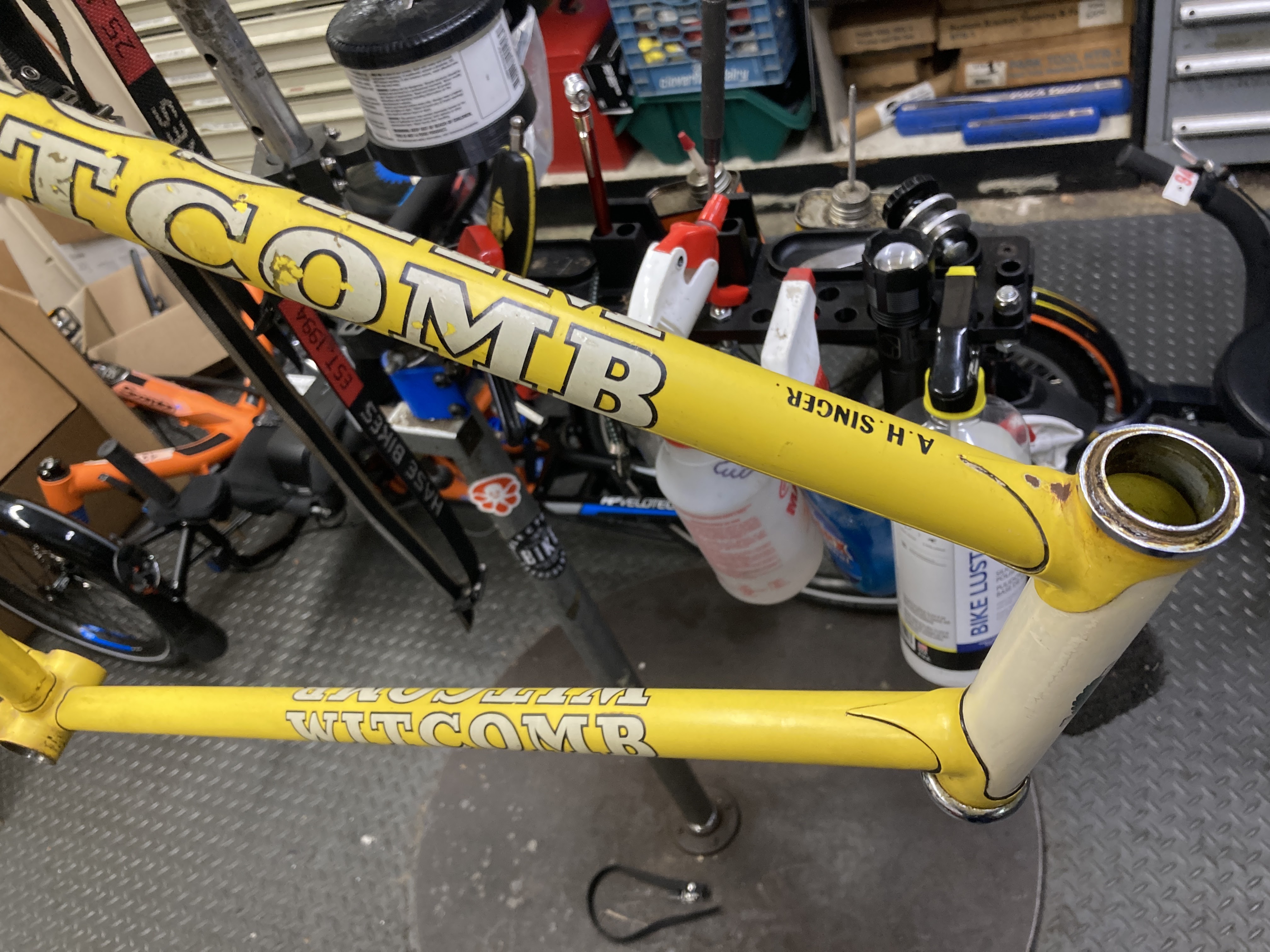
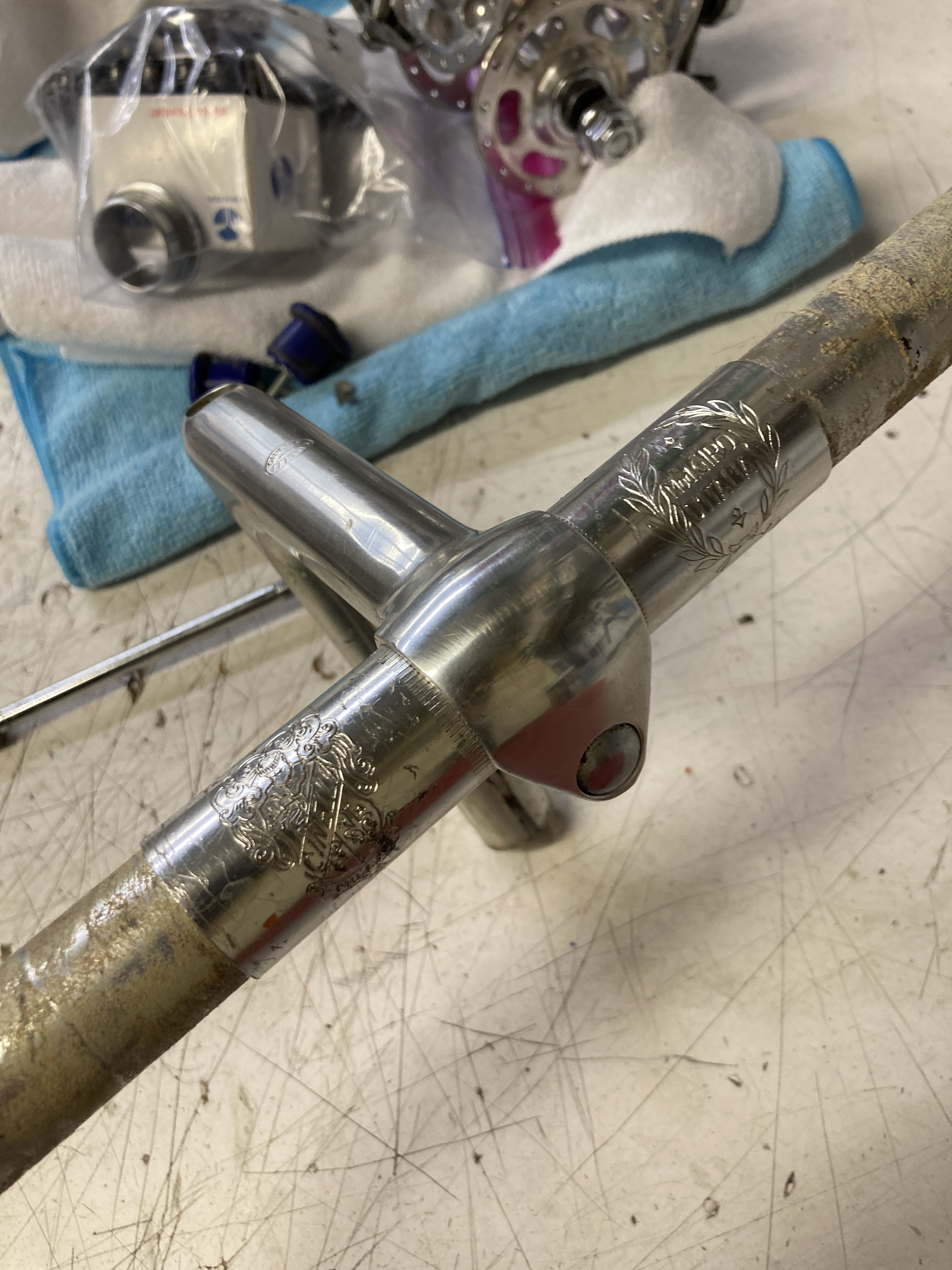
Over the last few days, I've had some time to get started, and learned a few things along the way. First, based on the serial number, it was built sometime in 1963, which makes it one of the older bikes I own. The seat tube measures 24", which is pretty much about as short as I'm comfortable riding in general, and the frame was built with Reynolds 531 butted main tubes. The seat stay cluster is kind of cool, using a "full wrap" design. I think most of the parts are original, aside from the Phil Wood sealed bearing bottom bracket and the Weinmann brake and levers. In fact, being a fixed wheel, it might have had no brake at all originally, since traditionally they don't come with brakes, and brakes are not allowed in a velodrome. The wheels have Campagnolo Pista (track) hubs, which have date codes indicating they were also made in 1963. The rims are MAVIC Championat Du Monde, and the tires are Clement tubulars (aka sewups). The crank is a Campy Pista with 165mm arms and 47 tooth chainring, for 1/8" chains, connected to a Campy track cog in back. The handlebars and stem are from Cinelli, though I'm not sure which model at this point.
 |
Full wrap seatstays
|
 |
Campy Pista 165mm cranks
|
 |
Campy Pista hub and cog, frame track ends with adjusters.
|
 |
Cinelli bars and stem, Weinmann levers
|
I breathed a sigh of relief when I discovered the seat post and stem both moved easily once the bolts were loosened. Sometimes you don't get that lucky, and it can be a huge challenge, and sometimes even completely impossible to budge those, rendering the frame pretty much useless. On the other hand, the tires were shot (not a big surprise), and the front rim has a huge dent in it. The rear rim MIGHT be ok, but honestly, I'm not that interested in using tubular tires on this bike, as the gluing and mounting process is kind of a pain, and not something I really love doing. A few of my other bikes do have sewups, but I try to keep it to a small number. So now I am working with a friend of mine who has a truly astonishing stash of bike parts, to see if he can come up with some good clincher rims that will look right on this bike. One oddity is that the front wheel has 32 spokes while the rear has 36. That actually makes a lot of sense, since the rear wheel sees more stress than the front, but you don't often see bikes that take that into account. Based on my experience, back in the day, it was mostly the English who thought of such things, as the classic 3-speed "light roadsters" often had 32 in the front and 40 in the rear.
I've taken all of the parts off the frame at this point, and started cleaning it up, including polishing the chrome "socks" on the fork and rear triangle. The chrome really cleaned up well, and the paint is looking pretty good too. I need to be careful not to damage the decals any more than they already are, and not harm the paint either. There's a little bit of rust on the bottom bracket shell where the paint got chipped, but nothing major. I need to take a closer look inside the tubes, but I think at worst there's a little light surface rust, which is not uncommon at all with older bikes, and isn't a real concern. Hopefully, over the next few weeks I will be able to rebuild the wheels with new rims and reassemble the bike and start riding it. I'm pretty sure I'll have the only Witcomb track bike on my local multi-use path!
 |
Painted parts of the frame are cleaning up pretty well.
|
 |
Rear chrome "socks" looking good.
|
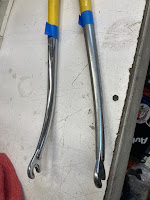 |
Left (in photo) fork leg has been polished, right has not.
|
I'll be posting updates as I move ahead with the work, along with photos, which you'll see here:
1963 Witcomb Track Bike