Showing posts with label Fuji. Show all posts

Sunday, September 5, 2021

Ever Onward! 1972 Fuji The Newest

 Sadly, I just have not found the gumption to post with any consistency on here, as anyone out there who's following knows all too well.  I think part of it is that I used bike projects as a major source of my material, and I just haven't had that many new bike projects or acquisitions lately.

But that just changed!  I'm in several bike related Facebook groups, and a few weeks ago, a fellow posted photos of a "barn find" bike that he said he planned to sell once he cleaned it up.  I immediately chimed in, saying I wanted to know about it when he was ready to sell. Well, it turns out I was the first to voice interest, so he offered it to me at what I consider a very fair price.

 So what the heck kind of bicycle is this that I jumped at the mere mention that it might be for sale?

1972 Fuji The Newest

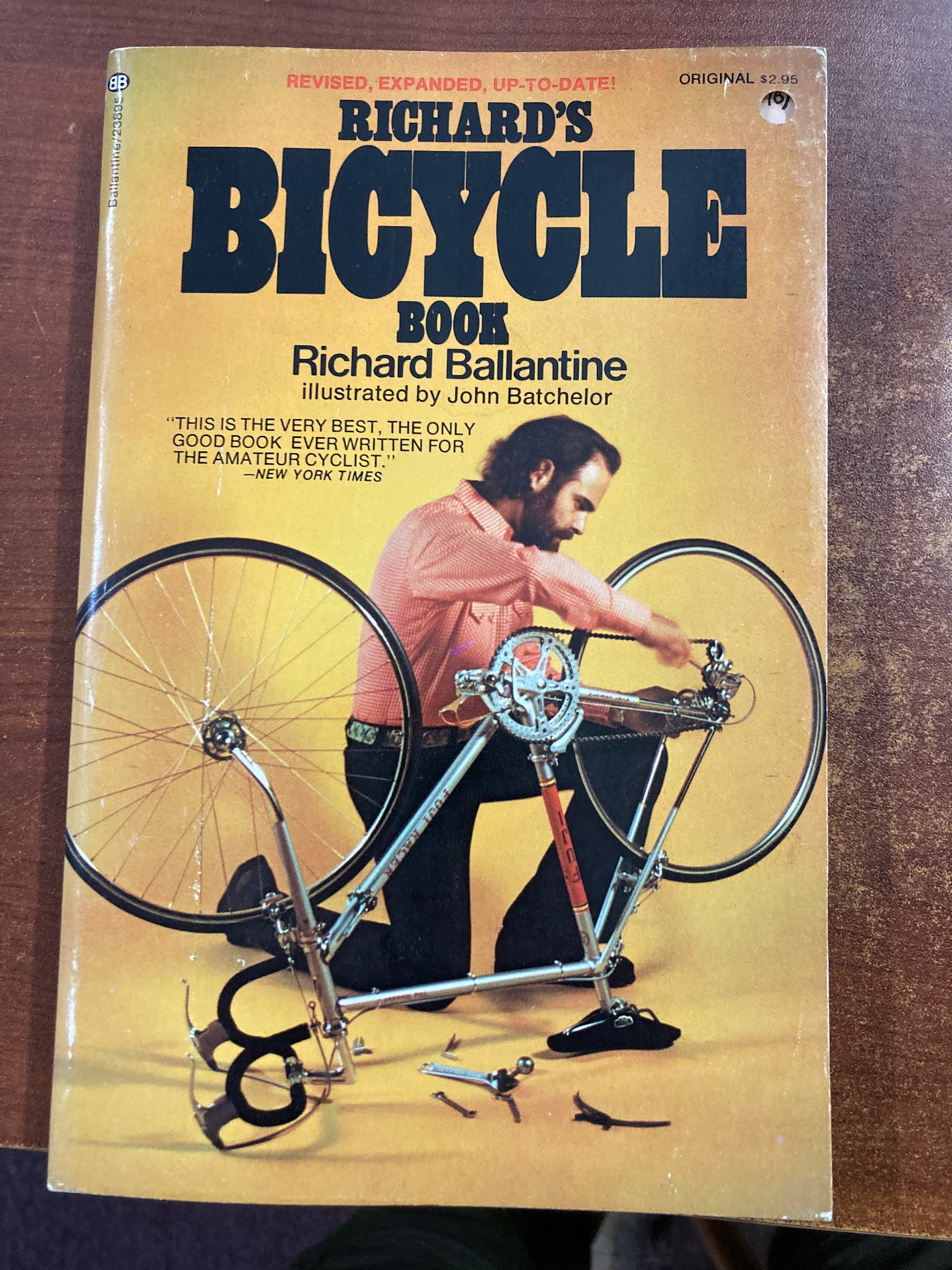
"Richard's Bicycle Book",
a classic of the 70s.
 For the answer, we need to go back to my first years falling in love with cycling.  I learned much of what I needed to know about bicycles and bicycling from the classic Richard's Bicycle Book, one of the classic cycling guides of the 70s.  The copy I owned at the time was the first revised edition, which had a photo of the author on the cover, working on a lovely Fuji road bike that said "Fuji Racer" on the down tube and "The Newest" on the top tube.  

 The author included a brief buying guide in one of the chapters, listing a few bikes at various price points that were well worth considering, and one of the entries in "good quality, high-cost bicycles" is the Fuji The Newest.  As a teenager I couldn't afford one, given that it sold for close to $500 at the time, but in 1977, when I bought the first bike I bought with my own money, I selected a Fuji S-10S, one of Richard's entries in the "good quality, low-cost bicycles", and had many wonderful times with that bike.  In fact, I still do, as you can see in "Fuji Finished and Fun!" and other posts here.

Description from 1974 edition of "Richard's Bicycle Book." Slightly different from the 1972 model.

One of the themes of my bike collecting as an adult is finding bikes I dreamed of in my youth, and the Newest was definitely on that list.  Which brings us back to the bike in question, a 1972 Fuji The Newest, that arrived this past week, and which I unboxed as soon as I had a free moment.  The seller did an amazing job of packing, basically double boxing the bike and padding everything with foam, as well as a layer of newspaper which prevented any nicks from cutting away the padding.  I don't think I've ever received a bike so beautifully packed, and the bike made the journey from Montana to Virginia with not even the slightest damage, which is a big deal these days.

Seamless Super YPC saddle.
On top of the great packing job, the seller had also done a complete tear down and overhaul of the bike, cleaning all the moving parts with an ultrasonic cleaner, as well as bringing the frame to a remarkable shine.  He'd said it seemed the bike had barely been ridden, and I have to agree.  There's no wear on the drive train or anything else, even the suede saddle looks unridden.  Just about everything on the bike is original, aside from the handlebar tape, brake lever hoods, and tires.  He had the original tires, but they were badly dry rotted, so he sold me the bike without the tires.  There are a few small spots where the paint was rubbed through, probably from storage, but the plus is that they reveal that the whole frame is chrome plated under the paint, just like my two Centurions and Specialized Sequoia.

Dia-Compe brakes,
Fuji headbadge,
chrome fork crown.
 It's a gorgeous bike, and should be a lot of fun to ride.  As much as I love the fact it's original, I will be making some changes to make it a better rider for my purposes, but will keep all the original parts handy, in case I go to a classic bike event or something.  What will I change?  Well, first of all, the seat post, which is really short, and to fit me, needs to be an inch or so longer.  The Newest was only made in 22 1/2" and 24" frame sizes, and this is the larger 24" (61cm), but that's at the lower end of my size range (61 - 64cm).  I also have rather large feet (size 13-14 depending on brand) and so the medium sized toe clips just won't work, nor the quill style pedals, which have a little "hook" on the outer edge that really doesn't work with wide shoes.  I'll probably ride it with SPD style pedals most of the time, or a different toe clip compatible pedal with larger clips.

SunTour V derailleur,
14-22 tooth SunTour freewheel.

The factory-original gearing is also something that needs to be addressed, as I'm not as fit as I was in my teens, and the 47/52 chainrings matched to a 14-22 tooth freewheel really only work for younger legs on flatter terrain than I have where I live.  Honestly, I wonder if that's part of why the bike has so few miles on it... these are NOT Montana gears!  Then again, the bike was originally sold in Minnesota, so who knows.  

SunTour Power Ratchet shifters,
Primus pump, sewup tires,
Fuji logo on fork.
Finally, I will most likely build up a second set of wheels, using clincher tires instead of the glued on "sewups" the bike currently has.  Sewups are great riding tires, if you buy the really good ones, but they require more work to properly install and repair.  I can't bring myself to rebuild the original wheels with different rims, so I'll build a second set and mount some nice riding clincher tires like the Rene Herse models or the Panaracer Pasela, which I have used for many years.


Every Onward slogan on right
chain stay.
Oh, why did I title this post the way I did?  Here's the answer - for whatever reason, The Newest had this slogan on the chain stays for the first few years of production.  Quirky, and made all the more so by that typeface.  But it's just another reason I love this bike.

If you want to see more photos of the bike, check them out here:  1972 Fuji The Newest

Left side 1972 Fuji The Newest.

Front right quarter 1972 Fuji The Newest.

Right rear quarter, 1972 Fuji The Newest.


Monday, October 21, 2013

Fuji Finished and Fun!

I've been meaning to post about this for a while now, but time seems to slip away faster these days.

A few days after my last post about my old Fuji, it was finished, ready to ride, and on its way with us to the Outer Banks, where we spent a week relaxing, walking, swimming, flying kites and biking.  It was a wonderful time, and I plan to write a bit more about that and post some photos soon.  No, really... soon!  :-)

For now though, I wanted to bring the Fuji tale up to date.   Here's a photo of it on the Outer Banks:

Finished and on vacation on the Outer Banks!

Turned our pretty sharp-looking, better than I had expected for a 36 year old bike that had sat neglected in a shed for many years.  Of course, it took some work to get her looking this good, but under the grime and dust the paint and chrome were in surprisingly good shape.

So, how is she set up? What are the parts?

First, you have a 1977, 25" Fuji S-10S frameset, lugged and brazed from double butted high tensile steel tubing. For the true geeks out there, it's got seat and head tube angles of 73 degrees, long chain stays, and a healthy amount of fork rake. I haven't measured everything, so I can't nail down truly accurate numbers, but it's got a front end geometry known as "low trail", which should make it handle front loads better than many bikes.

The other original bits and pieces are the crankset (with rings changed to 34x46 to better match a modern rear sprocket cluster and the more mellow riding I plan to do on it), both derailleurs, and the brake calipers. They all took some work to clean up and get working smoothly, but they're certainly good enough parts to use.  Crankset is a Sugino Maxy, which was an entry level alloy crank with "swaged" spider instead of a once piece forging, and I might swap it out for something fancier at some point. The derailleurs are typical SunTour of the era... VxGT rear, and SL front (with SunTour's "backwards" spring action, which takes some getting used to again), and the brakes are the classic DiaCompe centerpulls, which have always worked great, and have even been re-introduced in the last few years.

I was originally planning to keep the original 27" wheels, figuring they were good quality wheels, but the amount of corrosion on the spokes and nipples made me leery. So we went with a 700c set I had around with a 7 speed cassette hub, with a 13 - 30 tooth cassette to give me plenty of range. Tires are my favorite Panaracer Paselas in 32mm width (might put 35s on there eventually). At the front end I've got Velo Orange Porteur handlebars, Nitto Technomic stem, Dia Compe Guidonnet brake levers, and SunTour Power Ratchet Bar Con shifters, long a favorite of mine. For a saddle, I decided to try out a Brooks Champion Flyer that a customer graciously gave me when he found it didn't work for him.  It's sitting on a basic Kalloy Laprade seat post... inexpensive and reliable.  Oh, and the pedals are MKS Touring pedals, a nice wide pedal that works well with or without toe clips.

Accessories are minimal at this point.  SKS Chromoplastic fenders...again, inexpensive and reliable, and they look good too.  A Carradice Nelson Longflap saddlebag to carry my "stuff"... it's amazing how much you can cram in those.  I've hooked a couple of Planet Bike blinky lights on the bag, and mounted a CygoLite Expilion 700 on an Origin8 light mount that screws into the dropout eye and provides a short tube to take the light's handlebar mounting clamp.

All in all, I'm very happy with how the bike has turned out.  Thoughts about changes or additions?  Sure, but isn't that true with most bikes? I'm planning to add a Velo Orange Porteur rack to the front for hauling groceries, etc, and maybe a rear rack or saddlebag support of some kind.  Maybe a kickstand, as they can be handy sometimes, though I generally don't use them. I'd like to put something other than black bar tape on at some point, but it's not pressing. I MIGHT try swapping the wheels out for 650B size (smaller diameter rim, which would allow a fatter, cushier tire), but that would also mean changing the brakes and the fenders, and I'm not sure I want to do that.  We'll see... it's partly a matter of curiosity to try that wheel size on one of my bikes.  For now, it rides great as it is.
Here it is again, parked next to Christy's Velo Orange Mixte. Note the similar setup!


Friday, February 4, 2011

Old Friends

Well, Thursday was a good day, made all the more pleasant by a visit to the shop by an old friend. Phil and I were good friends in high school and into our college years, but as time went by and we both went on about our lives and moved various places, we fell out of touch. A few years ago, after I'd been back in the DC are a couple of years, we managed to hook up for lunch once, and caught up on each other's lives a bit. Then life took hold again and we fellout of touch for a while. Fortunately, we didn't go quite as long this time before reconnecting, and today he came out to see the shop.

It was great to catch up... a lot has happened in each of our lives over the years, but it's great to find there's still a bond between old friends. And I have to admit, it was fun showing him around the shop, and talking about this exciting new chapter of my life. And hearing him talk about his family was wonderful too. He's a good guy, and I suspect a great dad. Business was slow today (can you say January?) so we had time for a nice long visit.

One extra added surprise to the visit... and another reunion of sorts...

Back in 1980, I bought my Trek 414 road bike that I've written about before. Part of how I managed to finance that was by selling Phil my '77 Fuji S-10S. The Fuji was the first bike I bought for myself, rather than receiving as a gift from my parents, and I loved that bike. But being young and fickle, a few years later I wanted something "better", so I bought the Trek. And it was and is a better bike all around, no doubt about it, and I've had a lot of great rides and great adventures on the Trek. It's a bike I never expect to part with. But the Fuji always had a special place in my memory, as my first "good" bike, and the first paid for by my ow
n labor.

Imagine my surprise when Phil pulls up with the very same Fuji on the back of his car. And better yet, presents it to me as a gift! I knew he still had it after all this time, and he'd said he hadn't really ridden it in a long time, but I really didn't expect him to just show up and give it to me. It's a little dusty, and could use a good cleaning and probably an overhaul, but all in all in great shape, just like I remember, save for the Fujita leather saddle, which Phil discarded long ago. That sucker was made of some seriously thick and stiff leather, harder and less forgiving than the Brooks saddles I like so much. Still, it was a good saddle, and it's a shame it's gone... but that's a tiny quibble. It's SO good to see this bike again, and to think of fixing it up and riding it again!


Sunday, January 18, 2009

Yet Another Bicycle!

ANOTHER ONE?!?!?!?!? Well, um.... yes... bringing me to, well... er.... 18 and 1/2 bikes total right now. Yes, that's a lot of bikes!

What can I say? It's an obsession... I love bicycles! And I find it really, really hard to pass up a cool, classic, old steel bike when it's my size! Like the Fuji you see there to the left, which is a 1981 Intermediate Track model. A strange name, to be sure... I guess it was intended to indicate that it was a mid-level quality bike, not a true "pro" bike, but an excellent bike for anyone else. That is, anyone else who wants to ride a track bike!


Now, the real bike geeks in the audience can skip this paragraph, but someone out there is probably thinking "What's he mean by a 'track bike' and how is that different from any other racing bike?" Well, as the name indicates, track bikes are designed to be ridden on a closed course, oval track, known as a velodrome. Among the things that set them apart from road racing bikes is the fact that they use a single gear, with a drive train known as a "fixed gear" ("fixed wheel" to the Brits out there). As shown here, a fixed gear has a single chain ring, a single sprocket, and no "freewheel" mechanism to allow you to coast. That's right, you can't coast on these bikes. If the rear wheel is going around, so are the pedals. Think back to your first tricycle as a little kid, and you sort of get the idea. Except in this case, you're going a lot faster, a lot higher off the ground. Oh, and a true track bike has no brakes.

That's right, no brakes. In track events, the riders control their speed solely through using their legs to resist the rotation of the pedals and thus the momentum of the wheel. It's a very different sensation from riding a conventional bike with a freewheel, and it takes some getting used to. For one thing, if you TRY to just stop pedaling, the bike won't let you... the pedals will keep going 'round, and you'll get the distinct sensation of the bike trying to lift you up and toss you forward. It's not quite as extreme or scary as it sounds, but it sure gets your attention.


Now the observant among you are saying "Hey, wait, I see a brake on that bike!" Well, yeah. While some folks (who consider themselves purists, I suppose) ride true track bikes, sans brakes, on the road, I prefer to have a front brake there to help me out when I need it. For example, when I find myself on a steep downhill, and the pedals keep wanting to go faster and faster and faster, and my legs are having a hard time slowing them down or even keeping up. That's one of the interesting things about a fixed gear... when first they hear about it, most people immediately think "wow, that must make climbing hills tough!" In fact, the opposite is true... it's the downhills that are trickier, as your feet just keep going faster and faster and faster... a very odd sensation until you get used to it. And part of why I installed a brake on this bike. That and because you never know what might happen out there in traffic, and a brake can come in handy.

Now, friends of mine who know my tastes in bikes, will be surprised to see that front tire/brake setup. Why? Well, because that's a 23mm wide tire on there... a rather skinny one, and REALLY skinny compared to the 32-38mm wide tires most of my bikes have. But look closely and you can see there's no way I could put anything fatter under that brake or fork crown. You see, a track bike is designed to ride on the smooth (often wooden) surface of a velodrome, so there's no need for clearance for wider tires. We'll see how I like the ride like this... it's been a long time since I regularly rode such skinny tires, but back in my grad school days I went as narrow as 19mm, so who knows, I might like it a lot.

The true aficionados might actually be aghast to know that I drilled the fork crown out to accept that brake. It's true, and it might be considered blasphemy, but I really am a firm believer in having a brake for road use, and it's not like this is a truly high end, precious collectible. Sure, there aren't a lot of them left these days, but it was meant as more of an amateur's bike or training bike than a true, high end professional track bike. And aside from the frame, only the headset and crank/bottom bracket were original when I got the bike. Oh, and I have the original saddle, but haven't put it on, because it didn't work with the cheap seatpost I had handy. Maybe it will go back on when I get a nicer post. Anyway, I hope I haven't offended anyone too badly by drilling the fork... I have access to a really good drill press, with a very accurate and stable vise clamping assembly, so I knew I could do it safely and accurately. And wow, is that Fuji crown a big hunk of solid metal! No worries about structural integrity at all.

So far I've only tootled around the parking lot on it a little... it's been pretty chilly here lately. Soon though I hope to take her out on a good long shakedown ride, and get a feel for how she rides. I expect I am going to like it a lot. It's the fourth fixed gear bike I've owned, but the first one that came from the factory designed for the track. My earlier "fixies" (I'm not sure if I like that term or hate it... consider me torn) were standard road frames, converted to fixed gear drivetrains. This should be a rather different experience, I suspect.

For more information on this bike as it originally came from the factory, as well as other old Fuji info, see:

http://classicfuji.com/1981_09_IntermediateTrack_Page.htm

For more photos of this bike, as well as some of my other bikes, see:

http://flickr.com/photos/43828356@N00/sets/72157612697809218/

I've already had two friends tell me it would look better with a dark, forest green bar tape. Duly noted, and that's probably in the future. I had this tape hanging around for too many years. It was given to me by my pal Shawn, and I've been waiting for the right project to try it on. This seemed a good choice, and it's pretty nice for now. Thanks Shawn!

Coincidentally, the rear hub came from another friend, named Sean (they can argue over which is the "right" spelling), who happened to call shortly after I got the frame, and when I mentioned I needed a hub, said he had one he wasn't using. Good timing, huh?

Oh, and the "18 and 1/2 bikes"? The 1/2 is because I own a unicycle!