Showing posts with label schwinn. Show all posts

Saturday, October 15, 2022

My Other '73 Schwinn

Well, since I've actually managed to create a couple of new posts this year, let's see if I can keep it rolling.  The best way I think of to do that right now is to try to catch up on some of the bikes I have in my collection that I haven't written about.  Buckle up, because that's a surprisingly long list.  I don't know if I'll get to them all, but here's a start.  Some of you might have seen my posts about my 1973 chrome Schwinn Paramount.  The bike I'm writing about now was the next model down in the Schwinn product line, the Sports Tourer.

 Like many of my bikes, this is one I looked at longingly as a teenager.  We didn't really have a lot of Schwinn dealers near where I grew up, but they showed up in magazines and I got my hands on a catalog at some point, and got to know the various models.  Of course, like just about any cyclist in the 70s, I drooled over the top of the line, hand-built Paramount.  But another model in those catalogs that caught my eye was the Sports Tourer.  Made in the USA, and more affordable than a Paramount, it seemed like a great bike.  I didn't actually lay eyes on one until college, when a guy I shared an apartment with one summer had one, and that just made me want one even more, because in some ways it was like nothing I'd ever seen before.

1973 Schwinn Catalog Sports Tourer Page

 Now, when most people think about 70s Schwinns, the bike they are most likely to think of is the Varsity. One of the first things that comes to mind about that bike is the sheer heft of the thing.  While a lot of entry level 10 speed bikes weighed around 30 pounds, the Varsity tipped the scales at somewhere around 40!  Why is that?  And why was it so popular and sold in such huge numbers?  From what I've read over the years, Schwinn set out to build a 10 speed bike that could take the abuse dished out by a typical American adolescent, and I have to say, they succeeded.  While not light, they were definitely sturdy and durable, and you'll still see a fair number of them rolling along today.

The average person taking a quick glance at a Sports Tourer most likely wouldn't see a big difference between it and a Varsity.  While the Paramount used "lugged" frame construction, where the tubes are joined with the use of external sleeves, the Sports Tourer was built using "fillet brazing."  At first glance, the joints look a lot like the "electroforged" (welded) ones on the Varsity and other lower end Schwinns, but it's a totally different process, involving lower temperatures and higher grade steel tubing, to yield a lighter yet strong frame.  I won't get into the details, because it's better covered here:

https://www.sheldonbrown.com/schwinn-braze.html

And here:

 https://www.sheldonbrown.com/varsity.html

 For many years, the idea of having one of the fillet brazed Schwinns was on my "one of these days, if one happens along" list.  It didn't quite make the "gotta have it" category like a Paramount, or some of the other high end bikes like Mercian or Proteus or Masi, but it was always there in the back of my mind.  Well, a few years back, I don't recall exactly how I stumbled across it, but I found a Craigs List ad for what looked to be a very nice 1973 Sports Tourer.  The only challenge was that it was about 300 miles from me, but it turns out only about 30 minutes from my older brother, who understands my bicycle collecting, since he has a rather large number of guitars in his house.  A few emails and phone calls later, and the bike was in my brother's hands.  It took a few months to work it out, but on a trip to the DC area, my brother brought the bike to our mom's house, where I picked it up shortly after.  Based on the photos in the ad, I figured it was in good shape, but it looked even better in person.

1973 Schwinn Sports Tourer, as it was when I first got it.

 Once I got it back to the shop, I started looking it over and thinking about things I liked and things I wanted to change.  For the most part, the bike seemed to have all of the original equipment, with a few exceptions.  I decided I wanted to get it closer to original while at the same time making it more enjoyable to ride.  The parts that were definitely not original were the freewheel cluster, which was a very narrow range "corncob" style, more suited to a racing bike, and the tires, which were a narrow, high pressure black wall from Continental.  The white Dia Compe brake lever hoods were also most likely not original, as the levers themselves were made by Weinmann, which I believe was standard for Schwinn back then, and the catalog shows bare levers.  (Correction, the hoods were Weinmann, not Dia Compe.) Also, the bike had Huret shift levers mounted on the down tube, while the catalog shows it with the rather imposing Schwinn Twin-Stik stem mounted levers.  Finally, the original pedals would probably have been made by Lyotard of France, not the slightly more modern SR pedals from Japan.

Now that I'd assessed the bike and given it some thought, I made the following changes:

  • Installed a period correct Shimano freewheel with 14 - 32 teeth, with "skipped teeth" on the largest sprockets.  This gave me both a more practical gearing range and the same or similar to what would have originally been on the bike.
  • Swapped the tires for some new 27 x 1-1/4" Panaracer Paselas, which not only look right for the era, but ride great, both swift and comfortable.  Some of you have probably noticed a lot of my bikes have the Paselas on them, so I clearly like them.
  • Replaced the brake lever hoods with black ones, because while originally there would have been no hoods at all, I prefer the feel of rubber hoods.  Also, the bike would have originally had "safety levers" on the brakes as well, but I don't care for those either, so I left those off.
  • While I like down tube shifter levers, I like bar end shifters even more, and I happened to have a set of Schwinn-Approved bar end shifters (made by SunTour), which the catalog refers to as optional "fingertip controls", so I installed those.
  • Finally, while I could have probably found a pair of the correct Lyotard pedals (I might actually have had a pair in a bin somewhere), I really prefer the very similar looking, but better made MKS Sylvan Touring pedals, so I put a set of those and some extra large toe clips on the bike, to accommodate my size 13-14 feet.

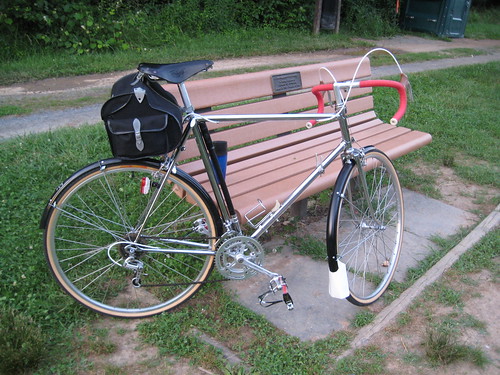
While I was at it, I gave the bike a thorough overhaul and cleaning, and even polished up some of the parts, like the funky Nervar triple crankset.  (Correction, as a reader pointed out, it's a DOUBLE crankset, not a triple.). The Brooks saddle that came with the bike was in excellent shape, but the bar tape wasn't that great, so I replaced it with a similar blue padded tape.  Finally, the spiffy little blue saddlebag was too cool to not keep, so it stayed on the bike, as did the classic Zefal HP pump.  

One of the nice features about the 1973 and later Sports Tourers is that they came with a Scwhinn-Approved Le Tour rear derailleur, which was essentially a re-badged Shimano Crane, one of the nicest shifting wide range derailleurs of the day.  Paired with the SunTour shift levers (a personal favorite), it changes gears just great.  The 1971-72 models had the Campagnolo Gran Turismo, which despite being made by the famous Italian company, didn't shift that great and was really, really heavy.  

I've thought about putting fenders on the bike, but haven't gotten around to it.  To be truly Schwinn-accurate, I'd probably have to find some chrome steel ones, but I'm not sure I want to add any more weight to what isn't a really light bike to begin with.  Of course, SKS (formerly ESGE) plastic fenders were popular back then, and even current models would look right.  Or maybe something shiny from Velo Orange, that's lighter but still shiny.   For now, I'll keep it as it is, and just watch the weather.

All in all, I'm really happy with how the bike turned out, and it's a lot of fun to ride.  Not the lightest or fastest bike out there for sure, but super comfortable and smooth. 

1973 Schwinn Sports Tourer, after overhaul and changes.

You can see more photos of the bike, both "before" and "after" shots, here:

1973 Schwinn Sports Tourer

A few links to other, similar bikes, and information on the line in general:

http://www.ironweedbp.com/ironweed-blog/chicago-fillet-the-1974-sports-tourer 

https://16incheswestofpeoria.wordpress.com/2012/04/29/40-years-later-the-schwinn-sports-tourer/ 

http://bikeretrogrouch.blogspot.com/2014/09/handbuilt-schwinns.html


Sunday, June 14, 2009

Short, Fun, Retro Ride

I know, those of you who know me, or follow this blog, are thinking "isn't EVERY ride a Retro Ride for you Tim?" And yes, it's true, the vast majority of my many bikes are what one would call retro. But tonight was a step further that way. Not a huge step... I didn't hop on a penny-farthing in wool knickers or anything like that... but a little more retro or "classic", you might say, than usual. To start with, I rode the '73 chrome Schwinn Paramount. It's probably the bike I've tried the hardest to keep "original", since it came to me nearly completely equipped with original parts. And when it was time to accessorize it, I went with things that were period correct... the New Old Stock Schwinn Touring Saddlebag, the Bluemels Club Special fenders. And tonight, before my ride, I dug out a pair of Campagnolo Superleggera track pedals, with Christophe toe clips and ALE straps. Can you say "old school"? I've previously been riding the bike with modern "clipless" pedals, but have been wanting to go with something more traditional. The original pedals for this bike would be the more common "quill" version of the Campy SLs, and I have them, but with wide feet like mine, the track pedals work better. I used to ride with clips and straps all the time.. I only tried clipless in the late 90s, long after most "serious cyclists" had jumped on that bandwagon. I think what won me over to clipless in a big way was the advent of cycling sandals that can take the special cleat for the pedals. I have to admit, I love riding in those. But sometimes I like something different. I've got several bikes set up so I can use cycling shoes OR regular shoes, and a couple with plain ol' flat pedals, and at any given time, I generally have at least one bike with clips and straps. So tonight I decided to set up the Paramount that way, and I'm glad I did. It just felt right to be cruising along on a lovely warm evening before sunset, feet in toe clips, hands in gloves with cotton mesh backs and leather palms, sans helmet. Yes, you read that right... I rode without a helmet! I generally wear one, and pretty much always on the road, but tonight I was on a rail-trail and in the mood for the wind in my hair I guess. And it just completed the trip down memory lane in a way... to a simpler time, when I was younger and less aware of my mortality... when my best buddy and I would cruise the streets after dark, with neither helmets nor lights, in a quiet neighborhood on the edge of Baltimore. Back when a grand total of 10 or 12 or 15 "speeds" on a bike seemed an embarrassment of riches. When we didn't need to don our lycra, and our special sunglasses and our special shoes, and our head armor for a simple ride around the quiet streets. Tonight was like that... a quiet evening, soft light of the fading sun, only a few folks on the path... my old steel bike feeling so comfortable and right beneath me... non-cycling shoes in toe clips... wind in in my hair... five sprockets on my freewheel... shifters that don't click into each gear, and mounted on the down tube... and cotton tape under my palms. Beautiful night, beautiful ride. About the only thing missing would be to have some kind of mechanical odometer... can you say Huret Multito? (the old bike geeks just chuckled to themselves)

Thursday, January 1, 2009

Paramount Update

Well, those of you that have been following my blog for a while, or have discovered it recently and went poking around the archives, know that about a year and a half ago I bought a '73 Schwinn Paramount from a friend of mine. If you didn't know that, see the posts below: http://spokesofawheel.blogspot.com/2007/08/my-new-bike.html http://spokesofawheel.blogspot.com/2008/01/newold-front-derailleur.html The Paramount was Schwinn's top of the line, hand built bike, made in both touring and racing models. Mine's the P15-9 tourer, and I love it. When I bought it, most of the parts were completely original. I changed a couple of things... a longer stem, new cables and housing, new tires, and "clipless" pedals for most of my riding. The last item is the only one that's just plain "wrong" period-wise, but since I do much of my riding in SPD style sandals, it's an anachronism I'm willing to live with. And if I ever feel the urge to be more "correct", I have a set of old Campagnolo track style pedals with toe clips and straps that will be just dandy for that, and work with my big feet. The original "quill" pedals don't make my size 13s happy, unfortunately, and besides, they are pretty beat up. Anyway, I have since made a few other changes to the bike, but have managed to stay with period parts. First, as noted in an earlier post, I replaced the "wrong" front derailleur it had with the proper Campy piece. Second, I replaced the two outer chain rings with slightly smaller ones... the originals were 36 teeth, 49 teeth and 54 teeth, and honestly, that gave me higher gears than I needed. Now it's set up with 36/47/52, and I'm a lot happier... with the (original) 14-31 five speed cluster in back, I have a pretty useful range of gears, and it's interesting to have a "half step" drive train again (http://sheldonbrown.com/gear-theory.html#halfstep). Most recently, I've added fenders to the bike, as shown in the photo to the left. I looked at and considered a variety of fenders, including some of the lovely Honjo alloy fenders that look very similar to older French fenders of the same period as the bike. In the end though, based on the advice of a trusted advisor, I opted for a set of black Bluemels Club Special fenders, which are actually a model made in the early 70s, so they are truly "correct" for the bike. I bought a New Old Stock (NOS) set of them on ebay a while back, and I have to admit, they look sharp. I had hoped to track down some red ones, but those are pretty rare these days, and the black might actually be a better choice, now that I see them on the bike. Most Americans eschew fenders, but I'm a big fan, as I have noted in previous posts. Finally, I hung a NOS Schwinn Touring Saddlebag from the Brooks B.17 saddle. I bought the bag from someone on the Classic Rendezvous mailing list (http://www.bikelist.org/mailman/listinfo/classicrendezvous), a fascinating group of folks that know a heck of a lot about older, classic bikes. The bag was made in England for Schwinn, by a company named Karrimor... sadly long gone, but I was lucky enough to find this one. Similar excellent bags are still made by another British firm by the name of Carradice (http://www.carradice.co.uk/index.html), but it's nice to have the original Schwinn bag. I also installed a small metal saddlebag support on the seat stays... you can just make it out in the photo to the right, the little silver wire under the bag. I don't recall the maker... something like Midland or something, another English company of that era. It helps to keep the bag from dragging on the tire, or resting on the fender, when fully loaded. All in all I think the bike looks more "complete" with the bag and fenders... ready to go on a real ride in the real world, which is what these touring Paramounts were designed and built for. I still haven't decided whether or not to make the leap to getting reproduction decals, and whether or not I feel brave enough to apply them myself, but I suspect that one day I'll do that, or have them done by a pro.

Check out photos of the bike here:  '73 Paramount P15-9

Saturday, November 15, 2008

A Piece of Cycling History

Well, here's one you don't see every day! This is a Campagnolo Gran Turismo rear derailleur, from the early 70s. Bike folk know Campagnolo (Campy for short, unless your British, then it's Campag) mostly for their fine racing derailleurs and other components. This one was intended for touring, and was designed with a wide range of sprocket (back of the bike) and chain ring (front) sizes in mind. And it's nothing like their famous Record series racing derailleurs in any way. They were light, pretty, elegant even. This one, not so much. It weighs in at nearly a pound, and it's made of stamped steel, with a lot of seemingly uneccessary bulk to it. I've always thought it had a vaguely "Klingon" look to it, with the pointy/swoopy thing going on at the front/top of the pulley cage. Until a few years ago, I had only seen one briefly, in passing, on a housemate's older Schwinn. Then my buddy Geoff at the Community Cycling Center found a Schwinn Sports Tourer and bought it. I don't recall what he ultimately did with the bike, but he decided right away he didn't want the derailleur, and I asked for it as a curiousity. Geoff was more than happy to be rid of it. I've kept it around as a little piece of history and a paperweight, and don't expect to ever put it on a bike. I'm all for period correctness, as long as it doesn't mean using a really bad piece of equipment, and from what I've heard, that's what the GT is. I've heard more than one person derisively refer to it as the "Gran Trashmo", and the esteemed bike technology historian (yes, there is such a thing) Frank Berto wrote "The Gran Turismo was arguably the worst rear derailleur to carry Campagnolo's name. I blew the whistle on it. The Gran Turismo was my litmus test for bicycle writers. If a writer praised it, it meant that he had never pedaled it or he was lying..." (The Dancing Chain, Van der Plas Pub., copyright 2000). The funny thing is, my 1973 Schwinn Paramount P-15 (http://spokesofawheel.blogspot.com/2007/08/my-new-bike.html) has its original "Schwinn-Approved" rear derailleur, a re-badged Shimano Crane GS, which was new to the Paramount that year. The '71 and '72 models actually came with a Gran Turismo instead! And that's why I'm glad I have a '73! If I had an earlier one, I'd have to decide between "correct" and "good"... and the Crane is both of those things, as well as prettier than the GT.

Wednesday, January 9, 2008

A New/Old Front Derailleur

This may be one of those posts that only a bike geek can appreciate... and an old bike geek at that. I mean a geek about old bikes, not an old geek, although... well, you get my point.

Anyway, I just recently bought the derailleur you see to the left there. It's a Campagnolo Record front derailleur from around 1973 or so, and I'm really happy to have found it. You may be asking why it is I'm excited about an old bike part. Well, there are a couple of things that make this item special.

First, in the early 70s, Campagnolo (Campy for short in the US, Campag in the UK) components were widely thought to be some of the best, if not the best, available. Sure, you had and still have aficionados of other brands of components, but all in all, Campy was seen as the cream of the crop. By today's standards, it might be seen as somewhat primitive, with none of the shaping and sculpting of the cage side plates that help modern derailleurs do their magic. But for the drivetrains of the day, in the hands of an experienced rider, this was as good as it got.

Second, it's in great shape for a derailleur of this age, and for the price I paid. Basically, it looks like it has never been used, which is rare for something this old.

Finally, and most importantly, it's the "correct" front derailleur for my lovely 1973 Schwinn Paramount P15-9. I bought the bike this past summer, and it has almost all of its original parts, with the notable exception of having a SunTour MounTech front derailleur from the 80s. I figured one day I'd get around to replacing it, but when I found this one being sold by someone on an internet list I read, I jumped on it. Now about the only part that isn't really "correct" on the Paramount is the rear rim, a Japanese Araya, rather than the original Weinmann. I'm not that worried about that, honestly, but if the right rim came up for sale, I'd get it.

Now all I have to do for this bike is get the period decals for it, which luckily are still available from Waterford Precision Cycles, the heir to the Paramount line, sort of. Oh, and I think the lugs should be outlined in red paint, but I don't know that I'll deal with that.


Oh, and I know the clipless pedals aren't the right pedals, and I have both the original Campy SL quill pedals and a set of the Campy SL track model that I prefer.

Saturday, September 1, 2007

My "New" Bike!

Okay, so it's not really new. It's new to me, but it was built almost 35 years ago. It's a 1973 Schwinn Paramount. Those of you who know older bikes, know that this is a good one. Those of you who don't are probably thinking "aren't those old Schwinns tanks???" Well, some of them were, like the Varsity, their low end 10 speed designed to take the abuse of adolescents. The Paramount, on the other hand, was their top of the line model, handbuilt in the USA, using high quality steel tubing (Reynolds 531 double butted), and excellent components. The funny part of it is that I used to look at Schwinn catalogs and dream of owning one of these, way back when this bike was new. There were of course other bikes I dreamed of, but the Paramount was really high on the list. And now I own one. And now I understand why they were so sought after then, and still are now, in some circles. It's a beautiful bike, especially in the full chrome finish that mine has (it was a special order option, I think). And the lugs are classic Nervex lugs, with the lovely curves, very nicely filed and cleanly brazed. And on top of it all, it rides great! I've only done short rides with it, but so far I love it. Smooth, stable, yet it feels light and nimble when I turn. And comfortable! About my only complaints so far are the fact that it has down tube shifters... no biggie, I rode with them for years, it's just I've grown accustomed to, and fond of, bar end shifters... and the gearing, which is set up as "half step plus granny". "What the heck does that mean?", I'm sure some are wondering. Well, with three chain rings up front, and five sprockets in back, the gear ratio differences between the two outer chain rings is basically half as big as the difference between each sprocket. This used to be a fairly common approach, and it was pretty versatile, and worked well with the components of the era. But it's very different from how most modern bikes are set up, and I haven't ridden a half step bike in years. I figure I'll give myself some time to get used to it, and if that doesn't work, I can change it. All of that aside, I'm having a blast riding the bike. And it sure is pretty to look at too.