Showing posts with label bikes of youthful dreams. Show all posts

Sunday, November 6, 2022

My 1981 Austro-Daimler Vent Noir II

Here's another one of those "bikes of my youthful dreams" machines.  As regular readers (are there any these days?) know, back when I was a teenager growing up in the DC area, one my favorite pastimes was visiting bike shops.  We had some really great ones, from basic "mom and pop" stores to ones that catered to real aficionados, with high end racing and touring bikes.  It  really was the classic "kid in a candy shop" kind of situation, but the "candy" cost way more than I could ever afford back then.

1976 A-D catalog
On one of my visits to College Park Bicycles, I spotted a really sharp looking bike from a company I really didn't know much about - an Austro-Daimler Vent Noir.  This was the first version of the bike, which came in a striking all black finish, with gold lettering and trim, and gold rims.  It also featured the first version of Shimano's Dura Ace component group, anodized in black to match the bike.  Vent Noir means "black wind" in French, thus the color theme.  Back then, there just weren't very many dealers for the brand, so it was a fun surprise to see one, and one so eye-catching.


A few years later, at the same shop, I spied a newer version of the same bike, the Vent Noir II.  While I'm sure others will disagree, I found the new version even more beautiful than the original.  The frame was treated in a "smoked chrome" finish that was really remarkable, and like nothing I had ever seen.  The component group had also changed, to Campagnolo, the brand that was the "top dog" in road cycling back then.  On the Vent Noir II, they used the Nuovo Gran Sport group, rather than the higher end Nuovo Record or top of the line Super Record.  Functionally the differences aren't really all that great, and even the finish and appearance, while not as spiffy as the Record groups, was pretty darned nice.  The one exception is the rear derailleur, which is really rather homely for a Campy piece.  It works just fine, but I understand why some folks back in the day substituted either a Nuovo Record unit, or something from another brand entirely.  If you go back and look at the post about my Mercian, you'll see the original owner specced the Nuovo Gran Sport group, but got the lovely Huret Jubilee derailleur instead.

Craig's List photo of Vent Noir II
I kept my eye open for a nice, used Vent Noir (either version) for many years, but they just aren't that common, and finding one in a 62cm or thereabouts wasn't easy.  Fast forward to 2016, when I found a Craigs List ad for one in Fredericksburg, VA, about an hour and a half (depending on traffic) south of me.  The photos looked good, so I took the drive down to see it.  For a bike as old as it was, it was in really remarkable shape, and a quick test ride confirmed that I would enjoy riding it for years.  On top of all that, the price was fair, so we closed the deal pretty quickly.


Once I got it home and got a closer look at it, I was even more impressed with the overall condition.  Most of the decals were in good shape, with only a few spots where they had been scraped off, none bad enough to really bother me.  It's an old bike, so a little patina doesn't bother me.  Mechanically, it was in very good shape too, and about the only thing mechanically I decided to replace was the brake and shifter cables and housing.  As "correct" as it would be to have kept the original parts there, I'm a fan of functionality, and a set of new, modern cables and teflon lined housing definitely made things work better all around.

The other things I decided to change were the various "contact points" - saddle, bar wrap, and pedals.  The bike came with a cheap plastic saddle with crappy foam, so that got replaced right away with a Brooks B17 Special with copper rivets in the honey brown color.  To match that, I also used matching Brooks leather bar wrap in honey as well.  That color really complements the smoked chrome frame color!  Aside from missing a dust cap, the Campy pedals were fine, but the "quill" design does not work with my big feet, so off they came, replaced by a set of double sided SPD compatible pedals.  I like riding in SPD sandals, so that was an easy choice.  I have more "correct" looking pedals and toe clips I can use if the spirit moves me, though.

Finally, the last thing I changed was the tires.  It came to me with a set of low end Continental Ultra Sports, in 700x23 size, which are pretty narrow and harsh riding for my tastes.  It will come as no surprise to those who know me that I swapped those out for a set of Japanese Panaracer Paselas, in 700x28.  I really like those tires, because they look great with the tan, skin wall sidewalls, and they ride great too.  Much smoother than the Contis, but still plenty "fast" for me.  I could probably fit a wider 32mm tire, but for this bike the the 28s just seem right.

The finishing touch was a Carradice Barley saddlebag in olive green with brown straps, which again just looks great with the finish on the frame.  I think all in all it's a really classy looking bike, not really "flashy" at first glance, but beautiful when you stop to look.  And how does it ride?  Great!  Smooth, light, and fast rolling, and it handles really well too.  It's more at the "race" end of the spectrum than some of my bikes, but not to much so that it's twitchy of uncomfortable.  Having finally gotten my hands (and butt) on one after all those years, my early desire to own one seems well founded.

Here she is, after the changes I made, except for the pedals.

Here's my Flickr photo album for the bike:

1981 Austro-Daimler Vent Noir II

And here are a few online resources about the bike and brand that I found really helpful and informative:

Austro-Daimler: The Bicycle That The Owner Of A Bösendorfer Imperial Piano Would Ride

Bikes to Like: Ritchie’s 1979 Austro-Daimler Vent Noir II

Classic Austro-Daimler Bicycles

In the shop: Austro-Daimler Vent Noir

1979 Austro Daimler Vent Noir II

1976 Austro Daimler Vent Noir

By the way, if anyone has a source, online or physical, for a 1981 Austro-Daimler catalog showing the Vent Noir II, I'd love to see it.

I should mention that Austro-Daimler was actually one label of a company called Steyr-Daimler-Puch which produced bikes under the names Steyr, Austro-Daimler, and Puch.  In the US, it seemed there were more Puchs than the others, but that might have just been in my area.  The Steyr labeled bikes I've seen have all been utilitarian three speed "city bikes" much like the old English Raleigh Sports and similar bikes.  They also built bikes for Sears in the 60s under their J.C. Higgins, Ted Williams, and Free Spirit labels, including one model with 531 tubing and Campagnolo components.  Yes, from Sears!  There are other folk who know a lot more about that chapter than I do, so you might do some searching if you're really interested.

Monday, October 3, 2022

Sometimes, bikes find me!

 Honestly, I haven't been seeking out bikes to acquire for some time now.  But in the last two months, I've had two bikes turn up, and both of them too good a deal to pass up!

First was a bike that I found out about through the IBOB (Internet Bridgestone Owners Bunch) mailing list.  A member of the list posted "Motobecane Grand Record looking for a new home (Free)."  It caught my eye because I've always been interested in the Grand Record and Grand Jubile models from Motobecane, so I read the listing.  The next thing that caught  my eye was that the poster said the owner of the bike (not them) really wanted to do things locally, but might be willing to ship if need be, and that they were close to MY shop, so I could probably help with packing it up.  The final piece of the puzzle was seeing the photos and description, indicating the bike was my size!  A few emails back and forth, and a trip in my car, and the bike was mine.

Waiting for rebuild.

It's pretty filthy and in need of a lot of tlc, for sure, but I can handle all of that.  When I got it home, I was trying to figure out why the front wheel was cockeyed, and discovered that the front fork had a pretty serious bend to the left.  But I have the tools and know-how to fix that, and took the opportunity to make it a teaching moment with one of my staff.  Win-win!

Now, given the amount of work it's going to need, plus having to give some thought to just how I want to use it and thus how I want to build it up, I've put that bike on the back burner for a bit.  That decision was finalized when the second bike showed up, as it is going to be easier and faster to figure out and get rolling.

 My shop works with an organization called Bikes for the World, that collects donated bikes and ships them overseas to be used for transportation, mostly in Africa and Central America.  People that want to donate bikes can drop them off with us, and once a week or so, BFTW comes by with a truck and trailer to pick up anything we've taken in.  Typically, my staff and I will cast an eye over the giant pile of bikes on the truck/trailer rig, and now and then something interesting will be there.  Last week, as I was walking toward him, the driver said "there's one here you should take a look at!"

Well, I went over and looked, and it was quite a surprise.  There in the truck was a tall, yellow bike with drop handlebars like a road bike, but it wasn't a road bike.  No, it was a track bike, a "fixed gear" or "fixed wheel" as the Brits sometimes call it.  Which is probably the appropriate term, since it was built by Witcomb Lightweight Cycles of London.  Witcomb never really had a huge presence in the US market, but US frame builders Richard Sachs, Peter Weigle, Ben Serrota, and Chris Chance trained there in the early 70s, later going on to be major figures in the US bicycle industry.  There was also a Witcomb USA for a few years, which included Sachs, Weigle, and Chance as builders, but that's a different story.

After a short discussion, in which we agreed the bike made no sense for any of the partners in Africa or Central America, and the fact that BFTW had just held their annual sale of bikes that didn't suit the overseas partners, I was offered the bike for a good deal.  Anyone who knows me would not be surprised that I accepted it!  I honestly couldn't resist, as it's a pretty uncommon brand AND uncommon style of bike, plus, I was pretty sure it was pretty old, 70s or older.  It was covered in a pretty good layer of dust and other filth, but it didn't seem to have any serious rust or issues, so I was really looking forward to tear into it and get it rolling again.  Apparently, it had been left at the local transfer station (aka, the dump), which seems a sad end for such a fine bike.  My best guess is the original owner passed away, and whomever ended up dealing with their stuff had no idea it was worth saving.  I'm sure glad it came my way!

Right off the truck, sitting in front of the shop.

Over the last few days, I've had some time to get started, and learned a few things along the way.  First, based on the serial number, it was built sometime in 1963, which makes it one of the older bikes I own.  The seat tube measures 24", which is pretty much about as short as I'm comfortable riding in general, and the frame was built with Reynolds 531 butted main tubes.  The seat stay cluster is kind of cool, using a "full wrap" design.  I think most of the parts are original, aside from the Phil Wood sealed bearing bottom bracket and the Weinmann brake and levers.  In fact, being a fixed wheel, it might have had no brake at all originally, since traditionally they don't come with brakes, and brakes are not allowed in a velodrome.  The wheels have Campagnolo Pista (track) hubs, which have date codes indicating they were also made in 1963.  The rims are MAVIC Championat Du Monde, and the tires are Clement tubulars (aka sewups).  The crank is a Campy Pista with 165mm arms and 47 tooth chainring, for 1/8" chains, connected to a Campy track cog in back.  The handlebars and stem are from Cinelli, though I'm not sure which model at this point.

Full wrap seatstays


Campy Pista 165mm cranks

Campy Pista hub and cog, frame track ends with adjusters.

Cinelli bars and stem, Weinmann levers

I breathed a sigh of relief when I discovered the seat post and stem both moved easily once the bolts were loosened.  Sometimes you don't get that lucky, and it can be a huge challenge, and sometimes even completely impossible to budge those, rendering the frame pretty much useless.  On the other hand, the tires were shot (not a big surprise), and the front rim has a huge dent in it.  The rear rim MIGHT be ok, but honestly, I'm not that interested in using tubular tires on this bike, as the gluing and mounting process is kind of a pain, and not something I really love doing.  A few of my other bikes do have sewups, but I try to keep it to a small number.  So now I am working with a friend of mine who has a truly astonishing stash of bike parts, to see if he can come up with some good clincher rims that will look right on this bike.  One oddity is that the front wheel has 32 spokes while the rear has 36.  That actually makes a lot of sense, since the rear wheel sees more stress than the front, but you don't often see bikes that take that into account.  Based on my experience, back in the day, it was mostly the English who thought of such things, as the classic 3-speed "light roadsters" often had 32 in the front and 40 in the rear.

I've taken all of the parts off the frame at this point, and started cleaning it up, including polishing the chrome "socks" on the fork and rear triangle.  The chrome really cleaned up well, and the paint is looking pretty good too.  I need to be careful not to damage the decals any more than they already are, and not harm the paint either.  There's a little bit of rust on the bottom bracket shell where the paint got chipped, but nothing major.  I need to take a closer look inside the tubes, but I think at worst there's a little light surface rust, which is not uncommon at all with older bikes, and isn't a real concern.  Hopefully, over the next few weeks I will be able to rebuild the wheels with new rims and reassemble the bike and start riding it.  I'm pretty sure I'll have the only Witcomb track bike on my local multi-use path!

Painted parts of the frame are cleaning up pretty well.

Rear chrome "socks" looking good.

Left (in photo) fork leg has been polished, right has not.

I'll be posting updates as I move ahead with the work, along with photos, which you'll see here:

1963 Witcomb Track Bike

Sunday, September 5, 2021

Ever Onward! 1972 Fuji The Newest

 Sadly, I just have not found the gumption to post with any consistency on here, as anyone out there who's following knows all too well.  I think part of it is that I used bike projects as a major source of my material, and I just haven't had that many new bike projects or acquisitions lately.

But that just changed!  I'm in several bike related Facebook groups, and a few weeks ago, a fellow posted photos of a "barn find" bike that he said he planned to sell once he cleaned it up.  I immediately chimed in, saying I wanted to know about it when he was ready to sell. Well, it turns out I was the first to voice interest, so he offered it to me at what I consider a very fair price.

 So what the heck kind of bicycle is this that I jumped at the mere mention that it might be for sale?

1972 Fuji The Newest

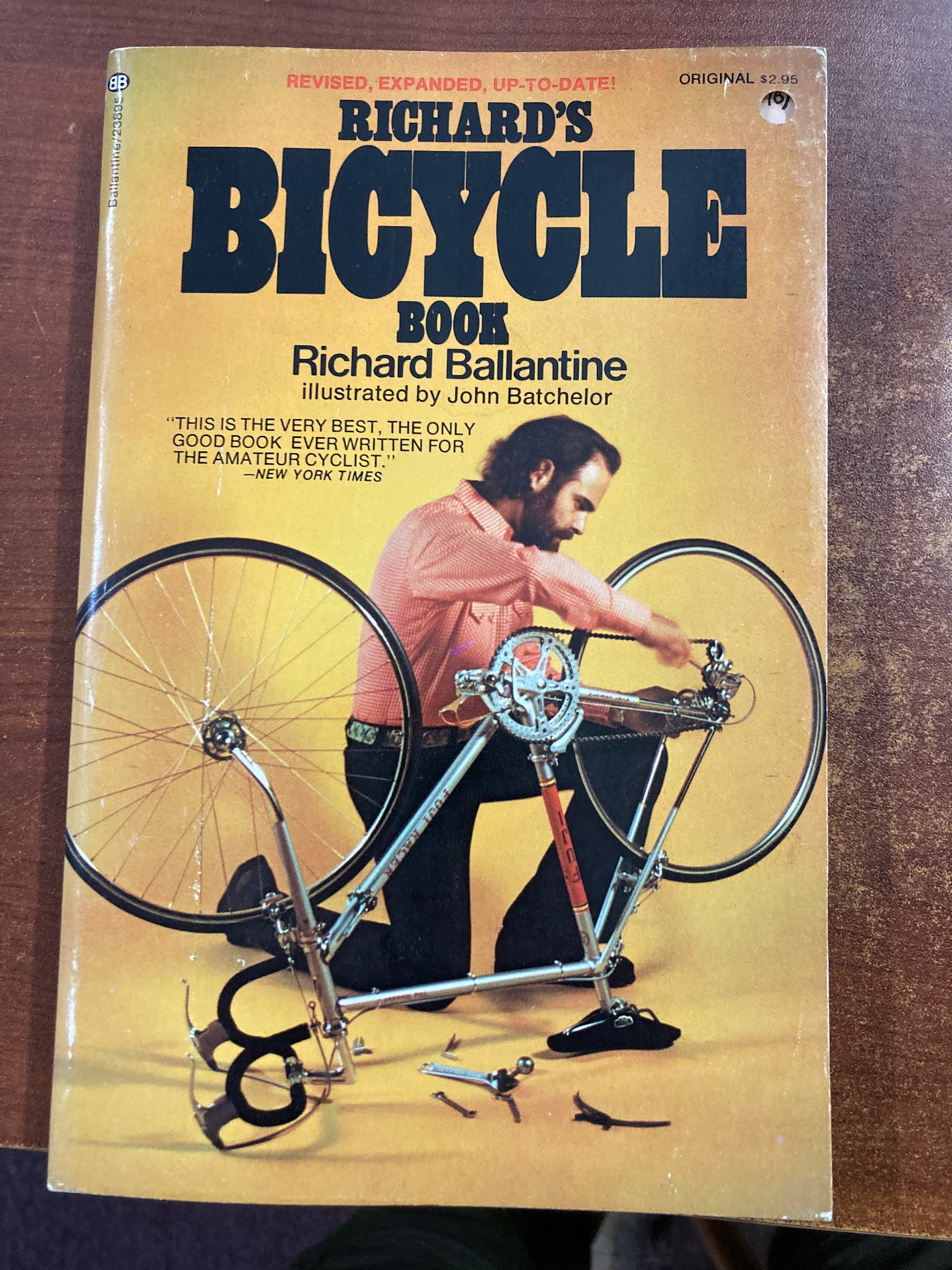
"Richard's Bicycle Book",
a classic of the 70s.
 For the answer, we need to go back to my first years falling in love with cycling.  I learned much of what I needed to know about bicycles and bicycling from the classic Richard's Bicycle Book, one of the classic cycling guides of the 70s.  The copy I owned at the time was the first revised edition, which had a photo of the author on the cover, working on a lovely Fuji road bike that said "Fuji Racer" on the down tube and "The Newest" on the top tube.  

 The author included a brief buying guide in one of the chapters, listing a few bikes at various price points that were well worth considering, and one of the entries in "good quality, high-cost bicycles" is the Fuji The Newest.  As a teenager I couldn't afford one, given that it sold for close to $500 at the time, but in 1977, when I bought the first bike I bought with my own money, I selected a Fuji S-10S, one of Richard's entries in the "good quality, low-cost bicycles", and had many wonderful times with that bike.  In fact, I still do, as you can see in "Fuji Finished and Fun!" and other posts here.

Description from 1974 edition of "Richard's Bicycle Book." Slightly different from the 1972 model.

One of the themes of my bike collecting as an adult is finding bikes I dreamed of in my youth, and the Newest was definitely on that list.  Which brings us back to the bike in question, a 1972 Fuji The Newest, that arrived this past week, and which I unboxed as soon as I had a free moment.  The seller did an amazing job of packing, basically double boxing the bike and padding everything with foam, as well as a layer of newspaper which prevented any nicks from cutting away the padding.  I don't think I've ever received a bike so beautifully packed, and the bike made the journey from Montana to Virginia with not even the slightest damage, which is a big deal these days.

Seamless Super YPC saddle.
On top of the great packing job, the seller had also done a complete tear down and overhaul of the bike, cleaning all the moving parts with an ultrasonic cleaner, as well as bringing the frame to a remarkable shine.  He'd said it seemed the bike had barely been ridden, and I have to agree.  There's no wear on the drive train or anything else, even the suede saddle looks unridden.  Just about everything on the bike is original, aside from the handlebar tape, brake lever hoods, and tires.  He had the original tires, but they were badly dry rotted, so he sold me the bike without the tires.  There are a few small spots where the paint was rubbed through, probably from storage, but the plus is that they reveal that the whole frame is chrome plated under the paint, just like my two Centurions and Specialized Sequoia.

Dia-Compe brakes,
Fuji headbadge,
chrome fork crown.
 It's a gorgeous bike, and should be a lot of fun to ride.  As much as I love the fact it's original, I will be making some changes to make it a better rider for my purposes, but will keep all the original parts handy, in case I go to a classic bike event or something.  What will I change?  Well, first of all, the seat post, which is really short, and to fit me, needs to be an inch or so longer.  The Newest was only made in 22 1/2" and 24" frame sizes, and this is the larger 24" (61cm), but that's at the lower end of my size range (61 - 64cm).  I also have rather large feet (size 13-14 depending on brand) and so the medium sized toe clips just won't work, nor the quill style pedals, which have a little "hook" on the outer edge that really doesn't work with wide shoes.  I'll probably ride it with SPD style pedals most of the time, or a different toe clip compatible pedal with larger clips.

SunTour V derailleur,
14-22 tooth SunTour freewheel.

The factory-original gearing is also something that needs to be addressed, as I'm not as fit as I was in my teens, and the 47/52 chainrings matched to a 14-22 tooth freewheel really only work for younger legs on flatter terrain than I have where I live.  Honestly, I wonder if that's part of why the bike has so few miles on it... these are NOT Montana gears!  Then again, the bike was originally sold in Minnesota, so who knows.  

SunTour Power Ratchet shifters,
Primus pump, sewup tires,
Fuji logo on fork.
Finally, I will most likely build up a second set of wheels, using clincher tires instead of the glued on "sewups" the bike currently has.  Sewups are great riding tires, if you buy the really good ones, but they require more work to properly install and repair.  I can't bring myself to rebuild the original wheels with different rims, so I'll build a second set and mount some nice riding clincher tires like the Rene Herse models or the Panaracer Pasela, which I have used for many years.


Every Onward slogan on right
chain stay.
Oh, why did I title this post the way I did?  Here's the answer - for whatever reason, The Newest had this slogan on the chain stays for the first few years of production.  Quirky, and made all the more so by that typeface.  But it's just another reason I love this bike.

If you want to see more photos of the bike, check them out here:  1972 Fuji The Newest

Left side 1972 Fuji The Newest.

Front right quarter 1972 Fuji The Newest.

Right rear quarter, 1972 Fuji The Newest.